Do Grounding Shoes Really Work? A Geneticist Tested RHIZAL — Here’s What Happened to Her Blood
We created RHIZAL shoes to make grounding easier. Just throw on your shoes, step outside, and rebalance your body’s electrical charge. And while we've always confirmed our shoes were in fact grounded, how could we really, really know if they’re having an effect?
We couldn’t…
Until now.
Over the last year, Jessica, known as @JessicaGenetics on X, has been conducting her own compelling studies on grounding to determine the impact of several variables on red blood cell (RBC) clumping (which we’ll get into in just a bit).
Jessica is a geneticist with a passion for biohacking, grounding, and all things health, so naturally, she caught our eye. And as luck would have it, we caught hers too.
In one of her most recent studies (back in June 2024), Jessica put RHIZAL shoes to the test.
Did they hold up? Spoiler alert: they did.
But if you’re like us, you want to get into those nitty-gritty details: How did she run her tests? What variables were there? What did she find?
Let's dig in.
Setting the Stage
Before we get into the research, let's introduce you to the main players: grounding, red blood cell clumping, and RHIZAL.
If you’ve found your way to this post, you probably already know what grounding is. But to cover our bases: grounding is the act of connecting your body to the Earth’s electrical charge. This can be done by walking barefoot on the grass, swimming in the ocean, walking on the sand, or any other activity that allows your skin to come into contact with a grounded surface.
What’s a grounded surface?
Anything that holds the natural electrical charge of the earth.
The idea is that by connecting your physical body to the earth, you can recalibrate your own electrical currents to a more natural state[*]. With the amount of artificial frequencies in our environment today, finding ways to ground out excessive electrical charges is crucial.
There’s some interesting research about how grounding may impact your physiology, but for our purposes here, we’ll stick to the impact on red blood cells. Which brings us to the next player in this story: RBC clumping.
Your red blood cells play a vital role in transporting oxygen and nutrients throughout your body, as well as helping you remove waste in the form of carbon dioxide[*]. When you experience red blood cell clumping (which is very common), it indicates that your RBCs aren’t moving around optimally, which could be due to immune challenges or toxin accumulation in your body (among other potential causes).
In theory, connecting your body to the earth and normalizing your electrical field should help keep things running smoothly. This is precisely why Jessica chose to study RBC clumping.
And then we have the final player: RHIZAL shoes.
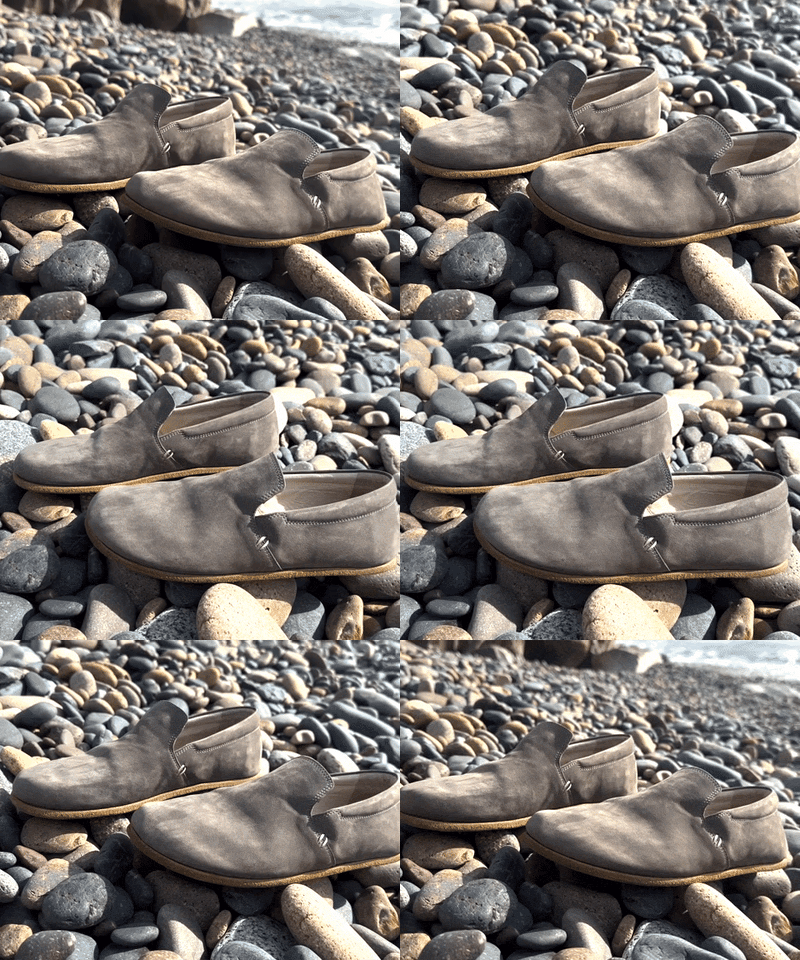
Rhizals are specifically designed to help you ground without having to go barefoot. While we’re massive fans of walking barefoot, those “no shoes, no service” signs finally wore us down, so we came up with the best alternative we could think of.
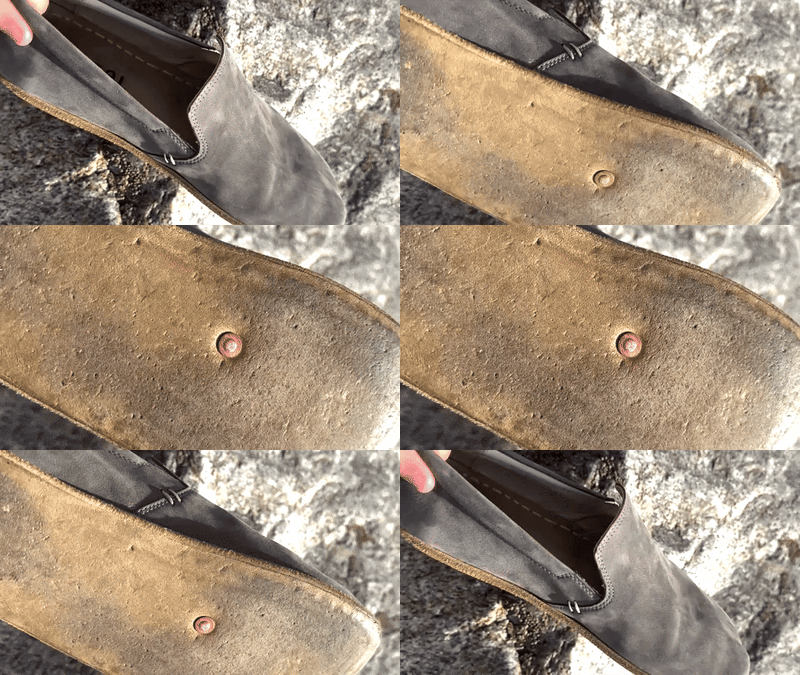
Our shoes are made with a copper plug through the sole that acts as a conductor to allow your bare foot (inside the shoe) to ground into the Earth. The rest of the shoe is made with natural materials to further optimize grounding.
Want to sneak some grounding in while you’re out running errands? Toss on a pair of Rhizals.
Alright, now that we’ve covered the basics, let’s dig into Jessica’s research.
Preliminary Experiments
Before she slipped on her pair of Rhizals, Jessica did quite a few experiments to assess the impact of grounding, addressing factors such as the amount of time spent grounding, and different grounding surfaces.
She determined the status of her RBCs in each experiment by taking before and after finger prick blood samples and examining them under a microscope.
Here are some highlights:
Grounding barefoot and RBC clumping
In her first experiment, Jessica wanted to determine if grounding outside barefoot had an effect on red blood cell clumping. As mentioned, RBC clumping indicates less-than-optimal RBC function. Could grounding help RBCs continue to move freely so they can do their job?
During this experiment, she sat outside barefoot for 30 minutes in the shade and saw a significant change in RBC clumping, as you can see below[*]:
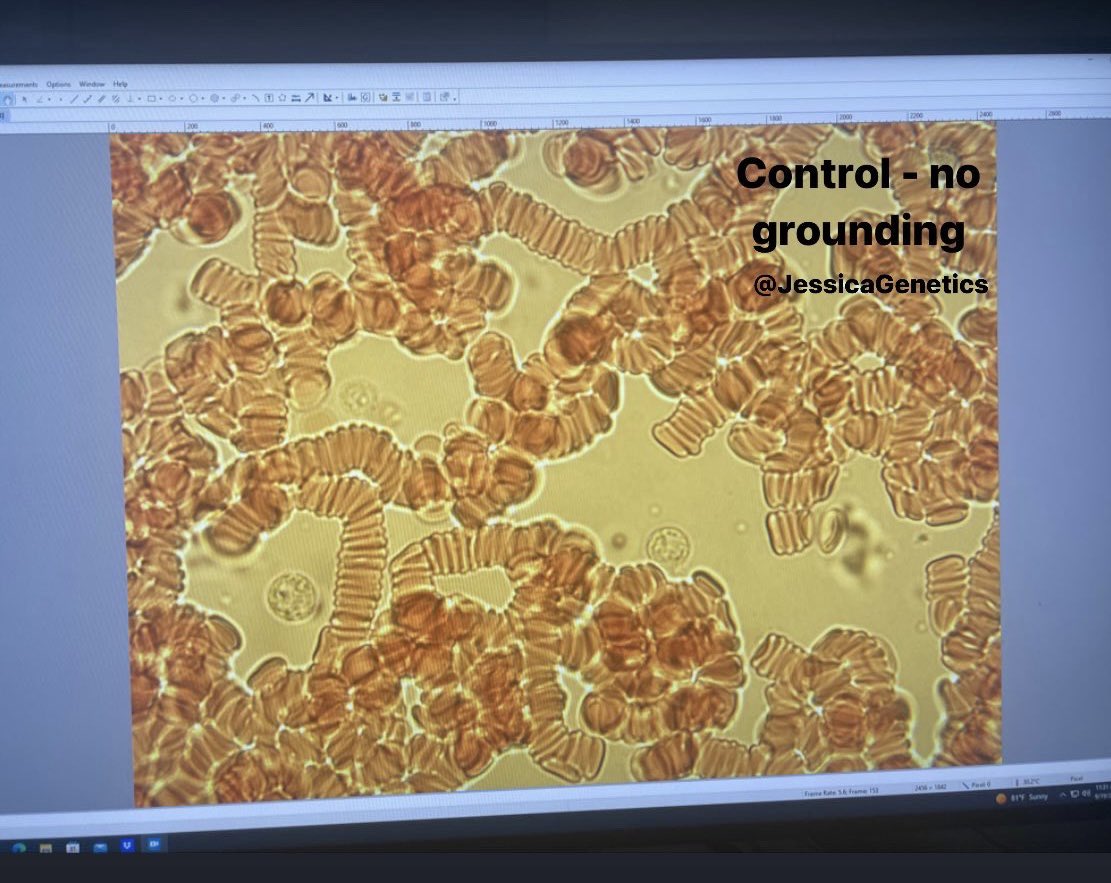
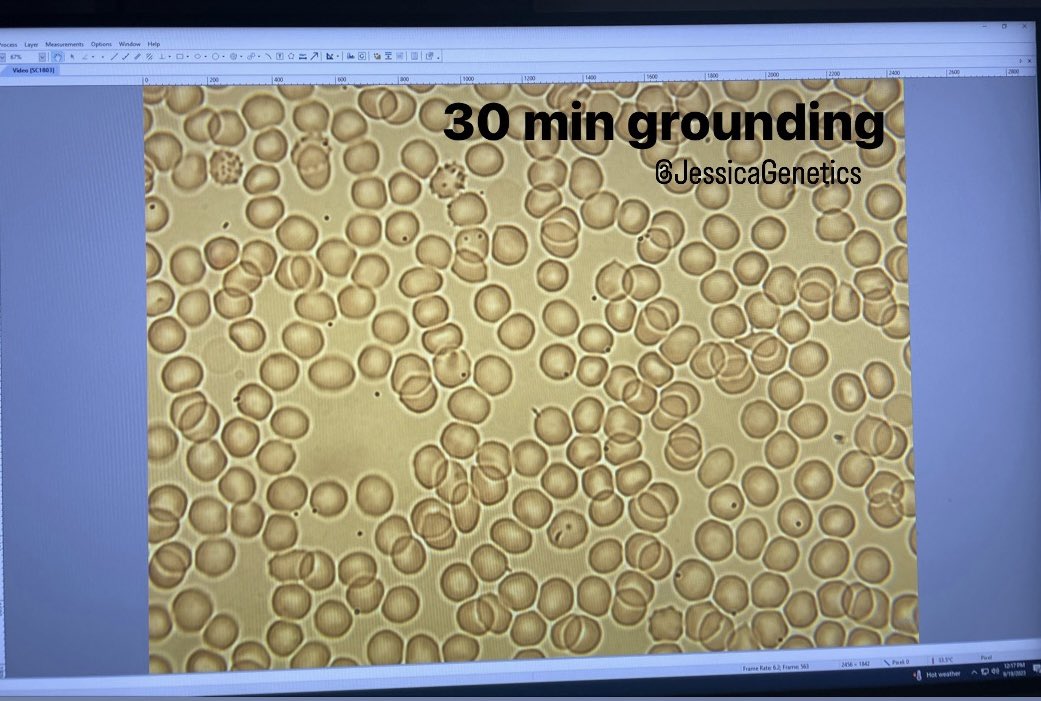
The takeaway: grounding does, in fact, have an impact on RBC clumping. Nice.
Grounding barefoot—how long does it take to see an effect?
Now that she confirmed the influence of grounding barefoot on RBC clumping, the next question was: how long do you have to stand outside barefoot for your body to respond?
For this experiment, she began with ten minutes of grounding barefoot, then tried five minutes, and finally one minute.
Ultimately, as few as five minutes of grounding barefoot produced a change in RBC clumping. (One minute didn’t do much)[*].
The takeaway: Even if you don’t have a ton of time for a grounding session—get those feet on the earth for five minutes, and your body will thank you.
Grounding on grass vs. concrete
Alright, so grounding on the grass can help keep those RBCs fluid, but what happens if you go barefoot on concrete?
It turns out that concrete does act as a conductor between your body and the earth. That said, Jessica’s result showed that after ten minutes of grounding on concrete, she still had some RBC clumping (although less than she had prior to going outside)[*].
The takeaway: Yes, you can ground on concrete. But grounding directly on the Earth is still better.
Which brings us to our main act…
…Drumroll Please…
After playing around with the different variables mentioned above, Jessica turned her attention to RHIZAL shoes. If grounding outside barefoot had such a significant impact on RBCs, could grounding shoes do the same?
Again, we created Rhizals for this exact purpose, but this was our first opportunity to truly see the effect in action.
After 30 minutes of standing in the grass wearing Rhizals, Jessica determined that the answer was a resounding—yes[*].
Now, before we get ahead of ourselves, she did note that grounding truly barefoot produced the most powerful effect on RBC clumping, but the changes she saw with Rhizals were very significant. Check out the images below:

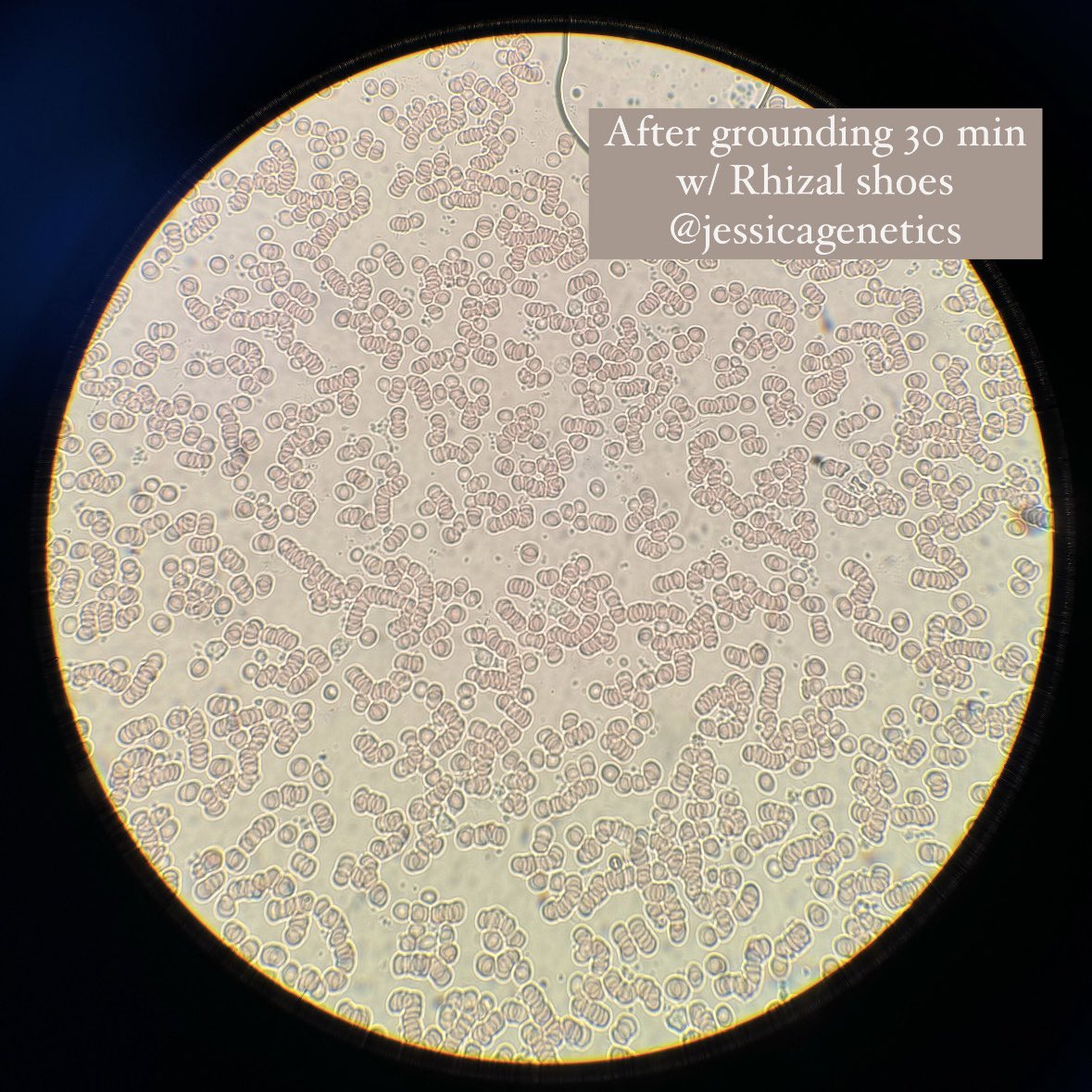
The image on the left is Jessica's RBCs before she went outside (her control), and the image on the right shows her RBCs after 30 minutes of grounding with Rhizals on.
See how there's more even spacing between the RBCs? That's what we love to see.
What we find particularly impressive about this experiment is the difference in surface area you get when grounding barefoot vs. the small copper insert in Rhizals.
When you're barefoot, the entire bottom of your foot acts as a conductor of energy that connects you to the earth. With Rhizals, the small copper insert in the shoe is the primary energy conductor. We knew that copper acts as a powerful conductor, but we were still amazed that our copper insert could produce such a profound effect despite its size. This is also due to our sole being nothing but leather.
Our Takeaway
Grounding barefoot is of course the gold standard.
That said, if you want to get some extra day-to-day grounding when running errands, taking your dog for a walk, or anywhere you're wearing shoes anyway—RHIZAL shoes are having an effect.
We do want to mention that this is an n=1 experiment, which means it's just a personal test and not a true published research study. While the results are indeed compelling, they should not be taken as true evidence and certainly not used as medical advice. More research will need to be done.
We're stoked to see where we go from here, and a huge thanks to Jessica for doing this on her own. We'll keep you posted on any new research that develops.
Now, get off your device and go ground it out.